 Okdalto
Possible Love
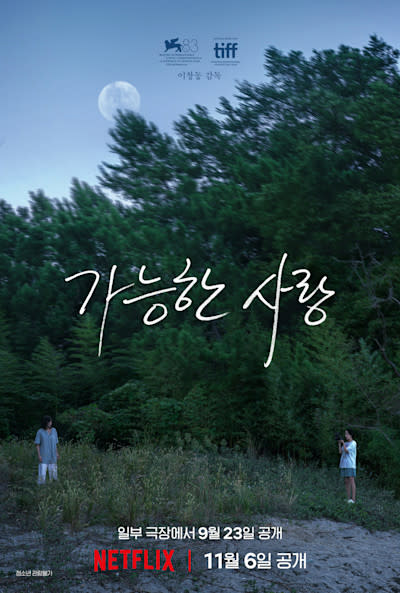
On my way out of Lee Chang-dong’s “Possible Love,” I found myself thinking about my grandfather and my father.
My grandfather worked on construction sites. My father does too. A day on a construction site starts well before dawn. So I have few memories of eating breakfast with my grandfather or my father as a child. My grandfather kept going out to do hard labor well into old age. He now lives in a house he, my father, and my uncle built with their own hands. Sometimes when I visit, he’s wearing an undershirt full of holes and drilling through concrete with a huge hole saw. Something about redoing the boiler pipes, or whatever. My grandfather is incredibly hardworking. Every day, he finds himself something to do.
There’s a concept called habitus. It’s a sociological term for the attitudes and dispositions shaped by the social and cultural environment you’ve lived in, until they become ingrained in you. My habitus began taking shape on the construction sites my grandfather worked on.
I was lucky enough to get the chance to stay in school for a long time. The further I went in my education, the more I noticed a change in the social standing of my classmates’ parents. One friend’s father was a professor, another friend’s parents were doctors, and another had grown up in a family of successful businesspeople going back generations. When I was in college, I went to see “Parasite.” On the way out, the friend I’d seen it with started talking about the housekeeper who used to come to their home. I was stunned. So there really were families who had housekeepers.
Some of my friends live in apartments in Seoul worth billions of won. Whenever I say, “Your family’s rich,” they always reply, “It’s not my apartment~” That’s true. But whenever I hear that answer, I think of people who worry about their parents’ old age. People who send their parents money every month, people who worry about the day their parents can no longer work. For some people, it isn’t their parents looking after their future; they’re the ones who have to worry about their parents’ future. Those friends probably know that lives like this exist. But they may not quite feel the weight of them. I can’t fully understand life on the other side either.
Thanks to all those years of schooling, I’m making my way toward a position that comes with a certain amount of social recognition. I’m doing a PhD, and I teach at a university. I strut around calling myself an AI expert, writing blog posts full of terms no one can understand. Not long ago, I went to a Frieze Seoul opening event. It was held in an incredibly luxurious mansion. Well-off-looking people had gathered to talk about artworks in several languages and meet buyers. People in obviously expensive clothes, gathered together so elegantly. It really was a refined affair. I found the whole situation strangely funny, and a little sad. Was this really where I belonged? What would my grandfather have thought if he’d been here? Suddenly I wanted to know.
When I teach, I often make fun of myself on purpose. I use memes and crack jokes to bring down the authority that comes with the title of doctor or the job of university lecturer. Is it really that big a deal? Building expertise deserves respect. But it doesn’t make someone a more impressive human being.
For an undershirt with holes, I prefer the colloquial “ppangkku nan nanninggu” to the standard “gumeong nan reoning syeocheu.” And “ssemen gongguri” feels more familiar to me than the standard words for cement and concrete. Maybe this is the habitus ingrained in me. At the same time, I can also write papers and speak in academic terms. All of these words are part of the vocabulary I’ve learned. Yet in some settings, the language I use becomes a credential that explains who I am, and in others, it becomes grounds for judging me. It’s ridiculous.
My mom can’t read the English on shampoo and conditioner bottles, so sometimes she asks me to read it for her. It hurts every time. Not because she can’t read English. What makes me sad is that someone might think she’s stupid for it. What’s even sadder is that I’ve internalized that way of looking at her too. Even in that ordinary moment when my mom asks me to read some English, the first thing that comes to mind is the gaze of someone who might look down on her.
I remember how it felt to see my grandfather’s thumbnail bruised black after he’d accidentally hit it with a hammer. I remember how it felt when my mom proudly told me about the shoes she’d bought on Coupang for 8,000 won. I remember how it felt when my father was laid off in a restructuring. My father is a ready-mix concrete truck driver. Like the character played by Sul Kyung-gu in the film, my father belongs to a union. The construction workers’ union under the Korean Confederation of Trade Unions. Sometimes he joins strikes too. Some people insult him, calling his union a “union of privileged workers.” Maybe some of my friends think that way too. That doesn’t mean my family has lived in financial hardship or unhappiness. It’s just how our family has lived.
Watching Zo In-sung and Cho Yeo-jeong in the film, I felt an oddly familiar anger. Especially in the scene where Cho Yeo-jeong’s character captures her family members’ most vulnerable moments on camera. The pain someone is going through right now becomes nothing more than a spectacle on the other side of the lens. What would happen if those characters met my family? If they saw my grandfather in his hole-ridden undershirt, drilling through concrete? I don’t know, but I imagine they’d be very kind. Still, I don’t think they’d see my family as equal human beings. That’s what makes me angry.
I’m proud of my family. But if that’s really true, why am I explaining all this at such length? As if I were trying to prove to someone that they’re people worthy of respect. I think those people won’t understand my family, yet I judge others by their social standing and demeanor myself. What a double standard. Maybe, by assuming in advance that they’ll look down on my family, I’m looking down on them first.
The fact that their gaze exists inside me too is deeply uncomfortable. Even so, I love my family. It seems very difficult for people with different forms of habitus to fully understand the lives each other has lived. Still, I hope we can try to understand each other, and love each other. But… is that a possible love?
Comments